What are automatic driving lessons?
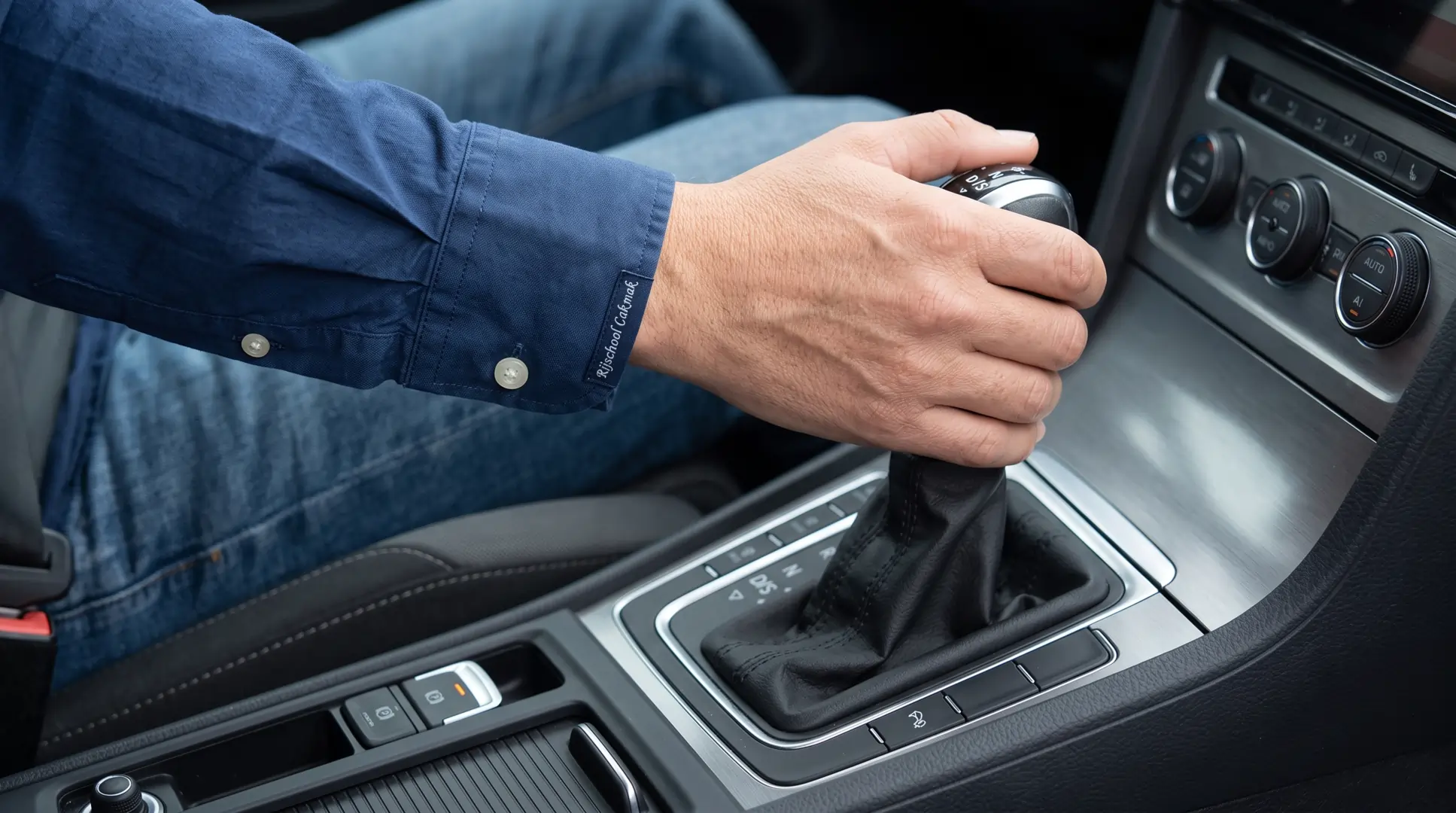
Automatic driving lessons take place in a car without a clutch or a manual gear stick like the one you'd find in a manual car. The car shifts by itself. You only operate the accelerator, the brake and the steering wheel, and you use the selector to choose whether you're going forward (D), in reverse (R), in neutral (N) or parked (P).
Because the shifting drops away, you can focus fully on what's happening around you from the very first lesson: judging traffic, using your mirrors, positioning on the road. Almost all electric and hybrid cars are automatics too, so anyone who wants to drive electric in the future is already practising in the type of car that will soon be the standard.
Manual or automatic: how do you choose?
The choice really comes down to one question: do you want to be actively busy with the car itself, or do you want to put all of your attention on the traffic? In a manual car you're continuously working the clutch, changing gears and metering the throttle. In an automatic all of that falls away, leaving you more room to look, anticipate and decide.
A manual gives you slightly more control over the car and results in a licence you can use in any type of car. Driving an automatic feels calmer, is less error-prone in busy city traffic and helps many learners build road awareness more quickly. At Çakmak Driving School we see in practice that the majority of our new learners deliberately choose automatic, for exactly that reason: focus on the traffic instead of on operating the car.
How does driving an automatic work in practice?
You have two pedals: the accelerator on the right, the brake on the left. You don't use your left foot. With the selector you choose one of four positions, usually labelled P, R, N, D:
- P (Park): parked, the drivetrain is locked. You use this position whenever you get out.
- R (Reverse): reverse. A gentle touch of the accelerator is enough to move.
- N (Neutral): comparable to neutral in a manual. Rarely used during normal driving.
- D (Drive): forward. You'll be in this position almost all the time, whether you're driving in the city or on the motorway.
At a junction you don't need to downshift: you brake, get back on the throttle and the car does the rest. In stop-and-go traffic you roll along by simply easing off the accelerator a fraction. On a hill the car holds itself in place as soon as you brake, so rolling back at traffic lights or in a steep car park is far less of an issue than in a manual.
In short: fewer actions, more attention for the traffic. Exactly what you need in a country full of cyclists, junctions and busy city centres.
Who are automatic driving lessons a good choice for?
Automatic lessons suit anyone who wants to be able to focus on the traffic from lesson one. In practice there are a few groups of learners who benefit especially:
- Learners who struggle with test anxiety and benefit from having fewer controls to think about.
- Those who mainly drive in the city, for example in Amsterdam, Haarlem or Beverwijk, where constant braking and pulling away in a manual is tiring.
- Learners who want to drive independently quickly and reduce unnecessary stumbling blocks.
- Anyone who plans to drive electric anyway. Electric cars are always automatic.
Manual is still a fine choice if you have a strong personal preference for it or ride a motorcycle a lot. But the question "can I handle it?" can almost always be answered with yes when it comes to automatic.
Automatic driving lessons at Çakmak Driving School
At Çakmak Driving School you get automatic lessons from instructors who understand what automatic learners need: a calm build-up, plenty of practice in real traffic and a lesson plan tuned to your own pace. We teach in the areas around Amsterdam, Haarlem, Beverwijk and the surrounding municipalities, so you practise directly in the traffic you'll take your test in later.
Important to know: we don't charge a surcharge for automatic. The lesson price is the same as for manual lessons, so choosing automatic never has to be a financial trade-off. Want to experience how automatic driving feels first? Book a trial lesson. Curious about how our driving programme in general is set up? You'll find that on the driving lessons page.
How many lessons do you need for your automatic licence?
On average, learners get their automatic driving licence faster than a manual one, simply because there's less to learn. Nationwide the CBR average for a manual programme is around 40 lessons. For automatic, in practice we often see a range of 25 to 35 lessons for the average learner.
Exactly how many you'll need depends on your age, how often you take lessons, whether you have cycling experience in busy traffic and how you deal with test nerves. After the first few lessons your instructor can already give you a realistic estimate and put together a lesson plan with you that builds up towards the exam.
The automatic driving test at the CBR
The practical test for automatic at the CBR is exactly the same as the test for manual, with one difference: you take it in an automatic. The examiner assesses precisely the same components: observation, independent driving using the sat-nav, special manoeuvres like the hill start and parking, and your overall road awareness.
If you pass, you get a full category B driving licence, with the note that you're authorised to drive an automatic. Çakmak Driving School has been in the top of the CBR pass rates in the region for several years running, and that also applies to our automatic learners.
Code 78: what does it mean for your licence?
If you get your licence in an automatic, your card will show the note code 78. You'll find this code in column 12 on the back of your licence, next to category B. It means that in the Netherlands you're only allowed to drive vehicles without a clutch pedal, in other words automatics and electric cars.
A lot of people wonder whether code 78 will disappear. In countries like Germany and Switzerland the automatic code has already been scrapped: anyone who passes there in an automatic with enough lesson hours is also allowed to drive a manual. That step hasn't been taken in the Netherlands and at the moment there's no concrete date. If you choose automatic now, you should assume code 78 will stay on your licence for as long as you drive in the Netherlands.
In practice most automatic drivers hardly notice it. New cars are increasingly automatic or electric, and both private lease and rental cars are widely available in automatic.
Ready to start with automatic driving lessons?
For many learners, automatic lessons are the fastest and most relaxed route to a driving licence. Want to experience for yourself what it feels like to sit behind the wheel without clutch stress? Book a trial lesson at Çakmak Driving School. Our instructors will help you decide in a single lesson whether automatic really suits you.